5 July 2026 · 5 min read
My Girl
I spent last weekend at Love Supreme. It was a glorious, blazing hot weekend — the kind of English summer day you stop believing in until you are standing in the middle of one. I was there, primarily, to support my kids' Samba band (that is a different journal entry, for a different day). What I did not expect was to spend an hour of the Sunday evening weeping in a tent with ten thousand other people, all of us shouting the same words at the canvas roof.
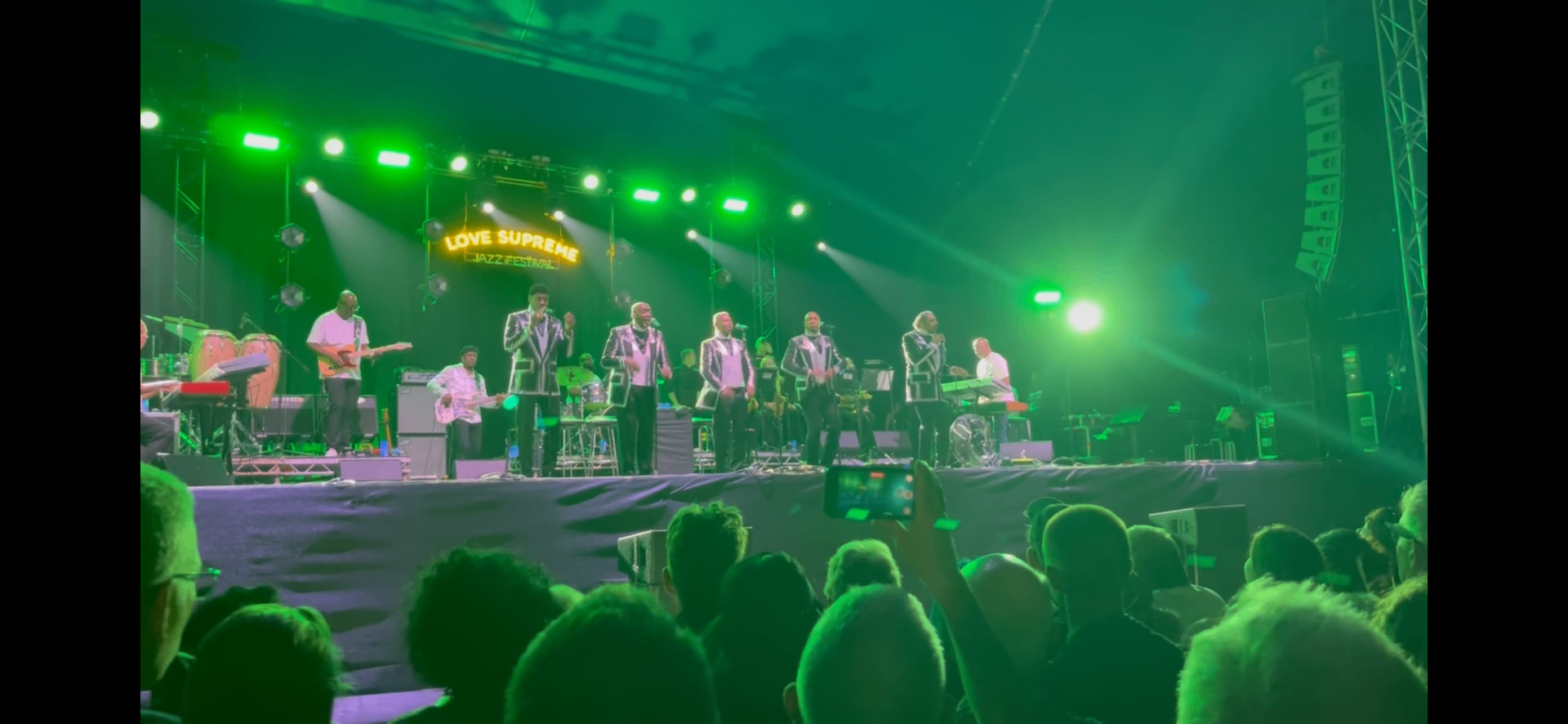
The Temptations played as the sun set. We were in the South Downs tent, the light going amber and then rose, and there was a particular hush before they took the stage. The original members are not young men anymore, and there has been a quiet understanding, I think, among everyone who follows them that this could be one of the last tours with any of the founding voices still on it. That knowledge sat in the crowd before the first bar was played. It gave the whole set the quality of a held breath.
Then they played My Girl. And the crowd did not simply listen. We sang it. All of it. The chorus first, then the verses, then the chorus again, louder each time.
I need to tell you why this landed the way it did. My Girl is my daughter's bedtime song. It is the one I sing to her, most nights, in a small dark room in South London, with my hand on her back and my voice barely above a whisper. That night, she got to hear it live — sung by the men who wrote it into the world — with everyone around her singing along. I looked down at her face and then back up at the stage and I could not tell you, honestly, which one made me cry harder.
What struck me, standing there, was the absolute absence of ego. Nobody was performing. There was no self-consciousness about whether your voice was in tune or whether you looked foolish with your face tilted upward and your mouth wide open. The self simply dissolved into the sound of the collective. For those minutes, the boundary between me and the stranger beside me did not exist in any way I could feel. We were one voice, and the voice was grief and gratitude and joy all braided together.
I have sat in a lot of rooms where people are afraid to be seen — boardrooms, coaching sessions, academic conferences. The fear of being judged, of saying the wrong thing, of not being impressive enough, is a constant undertone in professional life. And yet here, under a tent roof in Sussex on a blazing hot Sunday, ten thousand people had found the exact opposite state. No impression to manage. No status to protect. Just the raw, uncomplicated act of singing together because the song demanded it and we had the good fortune to be alive while it was being played.
There was a poignancy to it that I am still sitting with. The knowledge that we might be witnessing the final chapter of something irreplaceable. That the men on that stage have given us a lifetime of music, and that the lifetime is not infinite. The tears on the faces around me were not only about the beauty of the moment. They were about the recognition that moments this beautiful are borrowed. That legacy is not an abstraction. It is a group of human beings on a stage, singing until their bodies say stop, and a crowd singing back at them to say thank you, we remember, we will carry it forward. And for me, standing next to my daughter, it was also this: the song I sing to her at bedtime is older than either of us, and will outlast both of us, and for one hour on a Sussex evening we got to share it with the people who made it.
I left the festival with something quieted in me that had been noisy for weeks. That is what singing with ten thousand people does, I think. It reminds you that you are part of something continuous, something older and bigger than your own worry. And it leaves you with a question worth holding: where in the rest of my life do I allow myself to be that unguarded, that fully present, that completely without ego? Not often enough, I suspect. But I am trying to remember what it felt like, so I can find my way back.
Janine in action
Your next step
Make room for what matters beyond the role.
Executive coaching
If this has prompted you to think about identity, connection or the balance between work and life, coaching offers room to explore what you want to make space for.
Explore executive coachingExecutive team interventions
Bring a conversation about joy, connection and the people behind the job titles to your team through a bespoke leadership workshop.
Explore team interventions